Thu 4 Dec 2025
Article
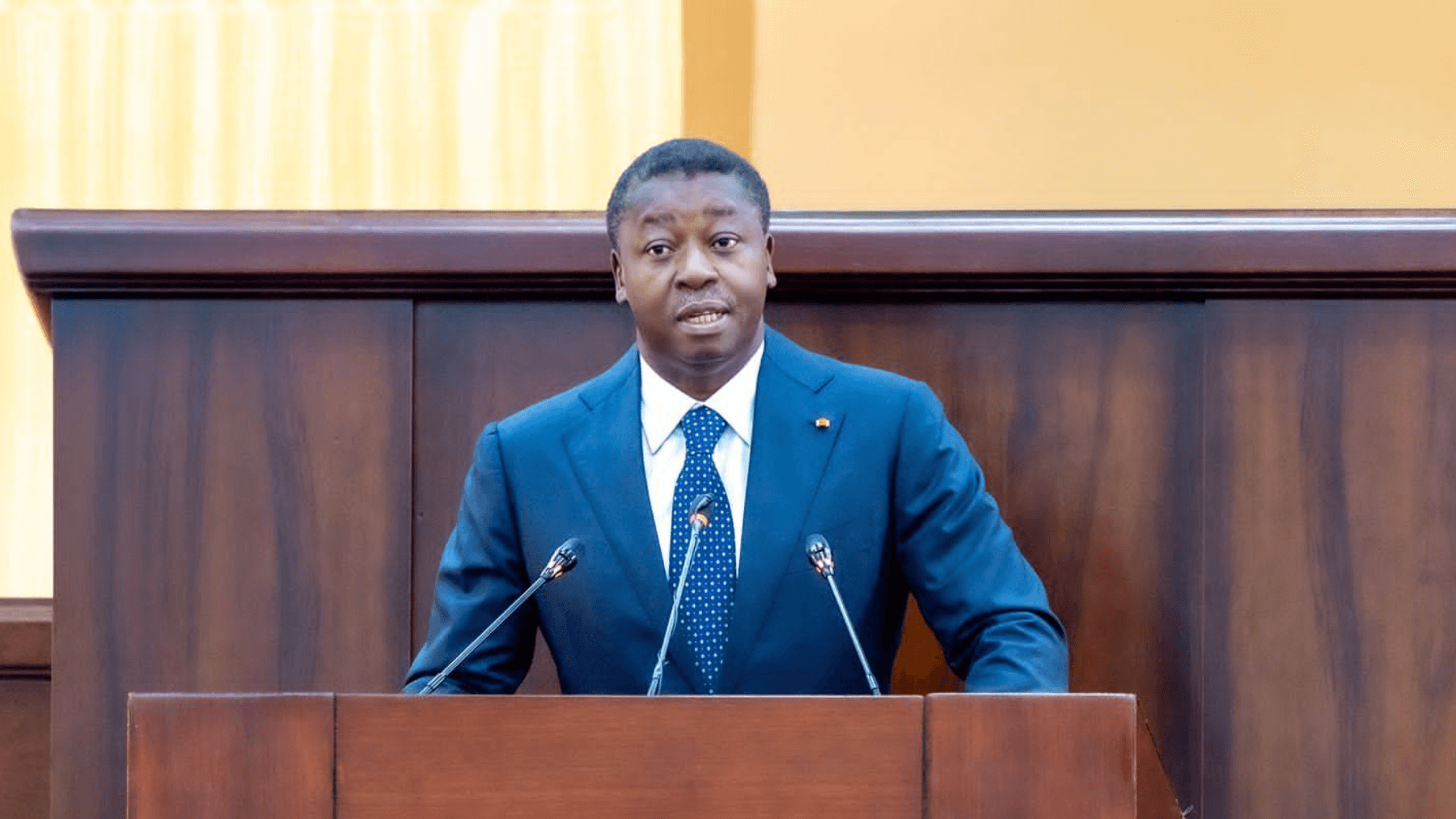
Faure Gnassingbé: A democratic speech asking twenty years of repression in Togo
"Democracy cannot tolerate a monologue. It is enriched by debate." This phrase, slipped into Faure Essozimna Gnassingbé’s speech before Parliament convened in Congress on December 2, 2025, in Lomé, is meant to symbolize a so-called “new institutional era” inaugurated by the Constitution that came into force over a year ago.
Yet behind this rhetorical display, nothing changes.
As a recent report by Tournons La Page demonstrates, Faure Gnassingbé has tightened his grip on the system: tailor-made constitutional revisions, contested electoral processes, and a security apparatus deployed as a safeguard. The rhetoric of openness poorly conceals the continuity of a carefully consolidated power.
The new Constitution and the Presidency of the Council
On May 3, 2025, Faure Gnassingbé became President of the Council, while Jean-Lucien Savi de Tové was elected President of the Republic by Congress. This reform concentrates real power in the hands of the Council President, who is also head of the majority party in the National Assembly, rendering the role of the President of the Republic largely symbolic.
The adoption process was widely contested:
- Deputies voted on the new Constitution just 10 days before legislative elections, while the terms of most parliamentarians had expired.
- The legislative and regional elections of April 29, 2024, allowed the ruling party UNIR to claim 108 of 113 seats.
- The Constitution was only published in the Official Journal in May 2024, after weeks of inaccessibility, preventing any citizen consultation.
Numerous voices opposed this maneuver:
- The Togolese Bishops’ Conference reminded that an Assembly at the end of its term cannot adopt a new Constitution and called for inclusive political dialogue.
- Forty-four Togolese academics denounced a blatant violation of the 1992 Constitution and constitutional revision rules, describing the process as constitutional fraud.
- Provisions of the ECOWAS Protocol and the African Charter on Democracy were also disregarded.
Repression and violence during the June 2025 protests
In June 2025, two waves of protests erupted in Togo against:
- The arrests of government opponents;
- Rising electricity prices;
- The 2024 constitutional reform enabling Faure Gnassingbé to consolidate his power.
These protests were severely repressed:
- 114 people were arrested, of whom 87 have since been released, 18 sentenced to twelve months in prison (11 suspended), and 9 still detained pending judicial investigation.
According to Prosecutor Talaka Mawama, security forces were confronted by protesters.
The repression was accompanied by tragic deaths: seven people, including teenagers and foreigners, were found drowned in two waterways in Lomé (the Fourth Lake of Akodésséwa and the Bè Lagoon).
A judicial investigation left unresolved for five months
The opposition, civil society, and Tournons La Page demanded independent investigations, highlighting cases of injuries, arbitrary arrests, and mistreatment by security forces and militias.
On July 6, 2025, the public prosecutor, Talaka Mawama, stated that a judicial investigation was underway to determine responsibility: “For all of these bodies discovered during the indicated period, a judicial investigation has already been opened against unknown persons and is ongoing,” he said on Togolese national television. However, five months later, no progress has been reported.
Prison conditions: Abdoul Aziz Goma
Abdoul Aziz Goma, an Irish citizen of Togolese origin, along with about thirty others arrested during an anti-government protest, has been arbitrarily detained since 2018.
On Wednesday, August 27, they announced the start of an indefinite hunger strike. Mary Lawlor, UN Special Rapporteur, called for his immediate release, noting that he is a human rights defender who has already been subjected to torture.
The UN Working Group on Arbitrary Detention concluded in 2023 that his detention violated multiple fundamental principles of international law.
Historical context: coups and Constitutional manipulations
Togo’s history is marked by coups and institutional manipulations:
- 1963: Assassination of President Sylvanus Olympio; Étienne Gnassingbé Eyadema, father of the current president, participates in the coup.
- 1967: Eyadema seizes power and establishes a dictatorship until 2005.
- 2002: Constitutional revision removing term limits, allowing Eyadema to run for another term.
- 2005: Eyadema dies; Faure Gnassingbé takes power through a triple coup (military, constitutional, and institutional). The April 2005 election, marred by fraud and violence, resulted in 400–500 deaths according to the UN.
Since 2005, Faure Gnassingbé has remained in power through controversial elections, successive constitutional amendments, and total control of institutions, including:
- Reintroduction of non-retroactive term limits in 2019, later manipulated to allow indefinite reelection.
- Adoption of the new Constitution in 2024, enabling the presidency of the Council without limits on real power.