Tue 31 Mar 2026
Article
Gabon: Tournons La Page launches a new momentum for democratic and inclusive governance
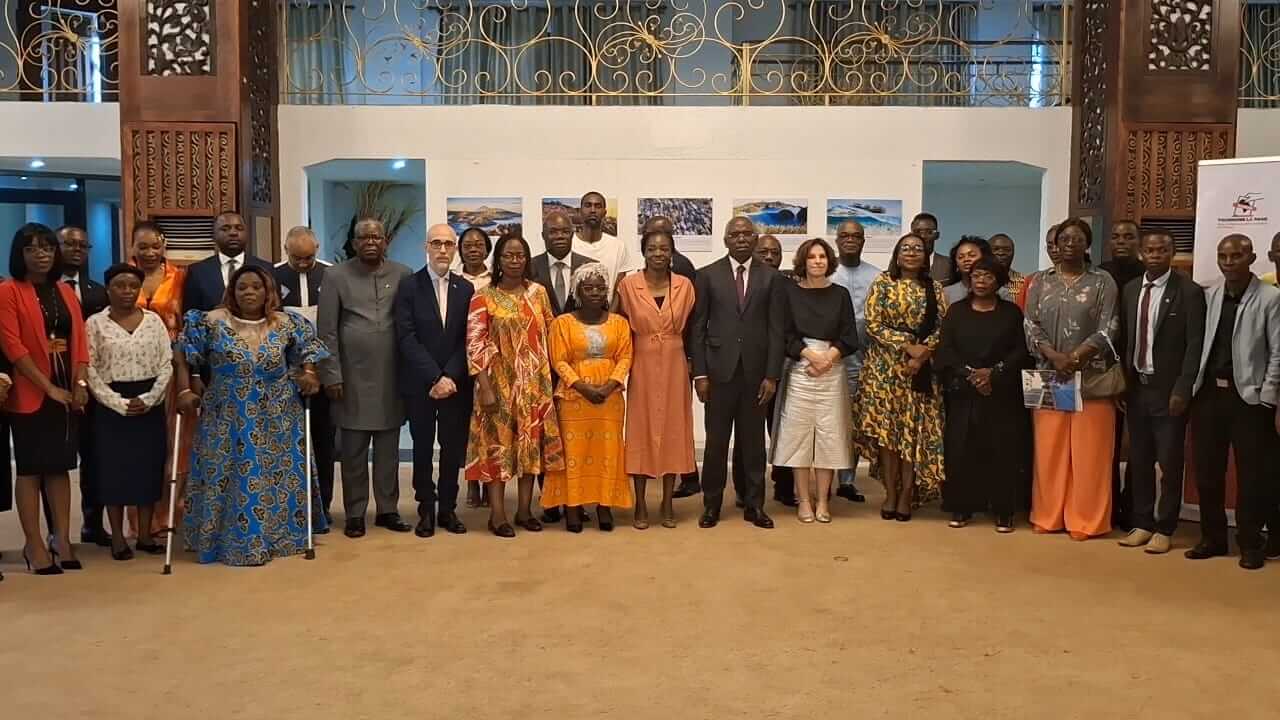
Members of Tournons La Page Gabon (TLP-Gabon) launched, on Friday, March 27, 2026 in Libreville, the project “For Democratic and Inclusive Governance in Gabon: Fostering Dialogue and Citizen Participation,” funded by the Delegation of the European Union (EU) in Gabon. The launch ceremony was attended by the Gabonese Minister of Reform and Relations with Institutions, François Ndong Obiang, the European Union Ambassador to Gabon, Cécile Abadie, as well as several other officials from the Ministries of the Interior and Justice.
This 24-month project aims to sustainably strengthen the capacities of civil society organizations. It is driven by a clear objective: to build strong bridges between citizens, civic actors, and public institutions, while fostering more active and informed citizen participation in governance issues.
At the heart of the initiative, 40 young leaders will be trained and organized into four operational units. These teams will work on strategic areas such as analyzing laws and public policies, rigorously documenting human rights violations, combating disinformation through fact-checking, and simplifying civic information to make it accessible to a wider audience.
As highlighted by Blanche Simonny Abegue, Coordinator of TLP-Gabon, the project addresses two major challenges in public debate: the lack of spaces for dialogue between civil society and institutions, and insufficient documentation in advocacy efforts. “Today, it is essential to base advocacy on verified facts, reliable data, and tangible evidence in order to strengthen its credibility and impact,” she emphasized.
A key partner in the project, the European Union reaffirms through this initiative its commitment to strengthening democracy. Ambassador Cécile Abadie noted that the program will help consolidate the role of civil society, both in advocating for reforms and in raising citizen awareness and evaluating public policies, in line with the country’s socio-economic development aspirations. She also stressed the importance of greater involvement of young people and women.
National institutions have also welcomed this momentum. Representing the Ministry of Justice, Yasmine Marat Abyla highlighted the positive evolution of civil society’s involvement in institutional processes, expressing hope that the project will promote more transparent governance, as well as a more structured, responsible, and proactive civil society in its watchdog and dialogue roles.
Beyond capacity building, the project includes the production of accessible educational content—such as analytical briefs, infographics, and digital publications—as well as the organization of awareness campaigns and multi-stakeholder forums. The goal is to foster constructive dialogue between institutions, civic organizations, and local communities, with the ambition of directly reaching at least 1,500 citizens.