Mon 26 Jan 2026
Article
Presidential election in Congo: Tournons La Page sounds the alarm over abuses and unveils its roadmap to defend democracy
Congolese citizens will head to the polls in less than two months for a presidential election in which President Denis Sassou-Nguesso—who was in power from 1979 to 1992 and continuously since 1997—is running for a fifth term. Despite more than 40 years at the helm of the country, he shows no intention of relinquishing power.
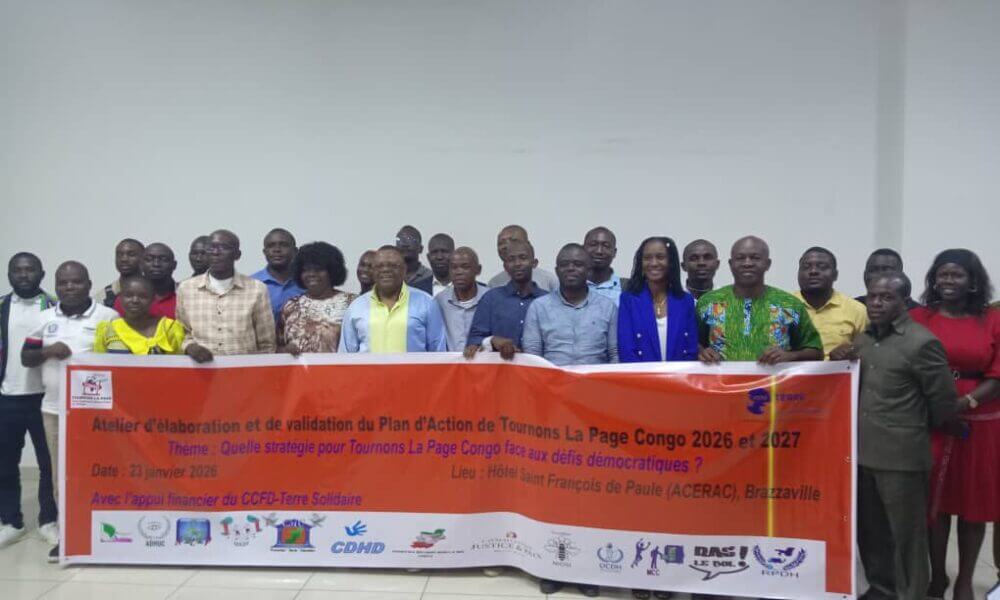
Faced with this situation, marked by the increasing entrenchment of the political and electoral system, members of Tournons La Page Congo (TLP-Congo) refuse to give in to resignation. Meeting on January 23, 2026, in Brazzaville during a strategic workshop, they adopted their 2026–2027 Action Plan, structured around a central question:
“What strategy should TLP-Congo adopt in the face of current democratic challenges?”
Alarming signals ahead of the vote
Discussions highlighted a worrying assessment of the national situation. Several security operations, officially conducted as part of the fight against urban crime, have been marred by serious human rights violations, including summary and extrajudicial executions, as well as repeated infringements on fundamental freedoms. For a large segment of the population, the line between maintaining public order and political intimidation is becoming increasingly blurred.
These security abuses are compounded by serious dysfunctions in electoral governance. TLP-Congo is particularly concerned about the absence of a reliable new biometric voter register, delays in implementing a fair electoral redistricting process, and the introduction of new eligibility criteria for local and legislative elections, which are perceived as discriminatory and exclusionary.
In addition, public statements by certain security officials aimed at restricting political and civic demonstrations have reinforced fears of a shrinking civic space. The accumulation of these factors is contributing to a climate of distrust and fueling the perception of a tightly controlled electoral process, to the detriment of political pluralism and citizen participation.
Unwavering determination in the face of democratic challenges
Despite this difficult context, TLP-Congo remains firmly committed. “It is imperative for TLP-Congo to refine its strategy in order to better respond to current challenges and to establish strategic planning capable of supporting effective advocacy for improved electoral governance and the release of political prisoners,” said Christian Mounzeo, Coordinator of TLP-Congo.
Members of the platform reaffirmed their commitment to defending public freedoms, promoting citizen participation, and ensuring respect for human rights throughout the electoral cycle. The 2026–2027 Action Plan adopted in Brazzaville is based on five strategic pillars: political advocacy, citizen mobilization, capacity building, organizational strengthening, and financial resource mobilization.
Direct engagement with candidates and a call for citizen mobilization
As part of the presidential election, TLP-Congo intends to question candidates about their vision and proposals on major issues affecting the population: the fight against corruption; access to drinking water and electricity; access to quality healthcare; improvement of the education system; development of transport infrastructure; the right to information; and equitable access to public services.
Beyond electoral mechanisms, TLP-Congo also questions the very meaning of political engagement: "Why run for office? For what kind of social project? How do the proposed platforms respond to the real needs of the population?"
Candidates are also challenged on their stance regarding political intolerance, restrictions on public freedoms, persecution of opposition figures, the existence of political prisoners, as well as their concrete proposals to combat corruption and the misappropriation of public funds.
“These questions must help foster genuine social mobilization—not only to prepare the population for a democratic transition, but also to encourage a paradigm shift in citizen engagement: monitoring electoral processes, changing electoral mindsets, and promoting peaceful protest,” concluded the Coordinator of TLP-Congo.